

PASSED RULES FOR 2025-2026:
- 2024-002. Allow Players Listed as “Doubtful” (D) to be Placed in the IR Spot
- 2024-003. Enable “Waivers to FA” on Sunday Only
- 2024-004. Remove Commissioner Lineup Changes and Enable Player Auto Subs to be Retroactive
- 2024-005. Remove Ability to Add Monday Night Players from Waivers on Monday
PASSED RULES FOR 2023-2024:
- 2022-001. Restrict All Rookie Draft and Taxi Squad Players on Their Original Teams from 20th Anniversary Reset
PASSED RULES FOR 2022-2023:
- 2021-002. Traded Taxi Squad Players Revert to Normal Keeper Rules
- 2021-003. League Reset for the 20th Anniversary Season
PASSED RULES FOR 2021-2022:
- 2020-001. Eliminate the Trade Review Period
- 2020-005. Add 2 IR Spots
- 2020-006. Change Bonus Point Structure to Favor QB Production
- 2020-008. Add an Extra Win for a Top-6 Weekly Score
- 2020-010. Taxi Squad Draft to Replace Rookie Draft
PASSED RULES FOR 2020-2021:
- 2019-002. Increasing Protected Players and Keepers
- 2019-004. 0-13 Teams Automatically Win “Putrid”
PASSED RULES FOR 2020-2021:
Overview: The proposed rule change would increase the number of protected players at the end of a season from 5 to 6; in addition to increasing the number of keepers selected in the following season from 3 to 4. This would add a protected player to the list submitted at the end of the 2019 season, while also adding an additional keeper player for the 2020 season. Accompanying this change will be a restriction on the number of players that can be kept at any one position (limit of 2).
Explanation: At the moment, managers are able to choose 3 (or fewer) keeper players from a previously submitted list of (up to) 5 protected players. This rule proposal will enable managers to choose 4 (or fewer) keeper players from a previously submitted list of (up to) 6 protected players. The submission and selection procedures would remain as detailed in the league constitution.
Given that we have instituted a superflex (QB/WR/RB/TE), the makeup and approach for the veteran draft has changed. As QB (and TE) are now more valuable, adding another keeper with the caveat that only 2 players may be kept at any position (other than QB, for which only 1 player may be kept) will allow more managers to plan for future years, but will also keep more impact players available in the Veteran Auction Draft pool.
Rule Language:
- Beginning in the 2020-2021 fantasy season, each team will be able to submit at least 6 players to be protected heading into the following season (this number does not include players under rookie draft contracts).
- After joining the league for the subsequent season, managers will be able to choose 4 (or fewer) keeper players from the previously submitted list of (up to) 6 protected keeper picks using the Yahoo interface. A maximum of two players per non-QB position (WR, RB, TE, and DEF) can be kept. A maximum of 1 QB may be kept.
- The league commissioner will confirm which 4 (or fewer) of the (up to) 6 submitted players will be designated as keeper players with each manager 2 days prior to the draft, at which time the manager may choose to proceed with keeping 1, 2, 3, or 4 of the players or dropping all of the players. There will be a limit of two (2) players that can be kept at any position. Managers may not choose a new player at this time, as non-locked players are released into free agency one week after the Super Bowl. Players not chosen as keepers at this time will be released into free agency.
Vote Required: A 2/3 rule (9 teams in a 12-team league) is required for the proposed rule to be confirmed and added to the League Constitution.
Enactment: This rule will affect the rookie draft, veteran auction draft, offseason transactions, or keeper selections. It will be enacted for the 2021-2022 season if confirmed by 2/3 rule.
Click here to go back to the top of the page.
Overview: The proposed rule change would include a clause in the “Putrid” award description that is any manager goes 0-13 in a season, they will be automatically given the “Putrid” award in that season. There will be no Putrid Playoff for that season.
Explanation: This proposal was brought about by the highly improbable scenario of Simon (Mr. steal yo Gurley) going 0-13 in the 2019 season. Many managers thought that it was likely unfair for a 5-8 team to have to battle it out with Simon for the “Putrid” trophy.
This rule proposal will automatically deem any 0-13 team as the “Putrid” trophy for that season, forgoing the Putrid Playoff.
Vote Required: A majority rule (7 teams in a 12-team league) is required for the proposed rule to be confirmed and added to the League Constitution.
Enactment: This rule will affect league format or prizes. It will be enacted for the 2020-2021 season if confirmed by majority rule.
Click here to go back to the top of the page.
PROPOSED RULES FOR 2021-2022:
Overview: The proposed rule change would eliminate the trade review period (24-hours) for in-season trades. In-season trades would immediately pass with post-hoc commissioner review.
Explanation: At the moment, in-season trades require a 24-hour review period. The commissioner reviews trades and rules within one day of receiving the trade proposal. In the case that the commissioner is one of the trading parties, the final decision will be placed in the hands of the appointed co-commissioner. If the co-commissioner is also one of the trading partners, the final decision will be placed in the hands of the prior year’s champion. Further succession of responsibility falls to the prior year’s runner-up, third place winner, etc.
This rule proposal will enable the commissioner to enact the “Immediate” trade review setting in Yahoo and allow trading parties to receive players immediately (unless a player has already played during the week of the trade–in this case, the trade will go through at the beginning of the following week). The commissioner review protocol listed above will then be applied in the 24-hour period following the trade agreement. Only clear cases of collusion will be flagged for return of players to the previous team.
Vote Required: A majority rule (7 teams in a 12-team league) is required for the proposed rule to be confirmed and added to the League Constitution.
Enactment: This rule will affect in-season transactions. It will be enacted for the 2021-2022 season if confirmed by majority rule.
Click here to go back to the top of the page.
Overview: The proposed rule change would change league scoring from 1 point per reception to 0.5 points per reception.
Explanation: This rule proposal was brought forward because of the recent move of many leagues from PPR scoring to 0.5 PPR scoring to ease the inflated scoring of full-point PPR. I cite the following article as evidence (“Fantasy Football: Standard, PPR or Half-PPR?”):
https://fantasysixpack.net/fantasy-football-standard-ppr-half-ppr/
In this article, it is articulated that 0.5 PPR tries to address the over-balance of PPR and not the under-balance of Standard, thus causing some problems of its own. Neither scoring system is perfect.
Vote Required: A 2/3 rule (9 teams in a 12-team league) is required for the proposed rule to be confirmed and added to the League Constitution.
Enactment: This rule will affect league scoring, format, schedule, in-season transactions, or prizes. It will be enacted for the 2021-2022 season if confirmed by 2/3 rule.
Click here to go back to the top of the page.
Overview: The proposed rule change would adjust QB scoring from 4 points per passing TD to 6 points per passing TD. Interceptions would be -3 points.
Explanation: This rule proposal was brought forward because of the recent discussion in fantasy circles surrounding the lack of spread in QB scoring. Since we have now moved to a superflex league, this point bears some further discussion. I cite the following article as evidence (“The 6-Point Passing Touchdown”):
The 6-Point Passing Touchdown
This brings up a good point–from a standard redraft standpoint, QBs should go early and often in superflex and 2 QB leagues. If they are 6-pt per passing TD, it would make them slightly more valuable, but regardless, they will have a large value in either scoring format. In addition, if you boost passing points (yards or TDs) it mildly changes the advantage running QBs have over regular pocket passers, but only a little. Other than that it has no quantifiable difference–all the QBs get the passing boost and the same superflex QB ideas still apply.
Vote Required: A 2/3 rule (9 teams in a 12-team league) is required for the proposed rule to be confirmed and added to the League Constitution.
Enactment: This rule will affect league scoring, format, schedule, in-season transactions, or prizes. It will be enacted for the 2021-2022 season if confirmed by 2/3 rule.
Click here to go back to the top of the page.
Overview: The proposed rule change would adjust QB keeper values (and only QB keeper values) to be more representative of the increased value of QBs in a superflex league.
Explanation: At the moment, the keeper values for the league are based on Yahoo pre-draft values, which are determined based on the standard lineup format of 1 QB, 3 WR, 2 RB, 1 TE, 1 W/R, 1 DEF. Because our league has the format of 1 QB, 2 RB, 3 WR, 1 TE, 2 W/R/T, 1 Q/W/R/T, 1 DEF, there is an increased value of the QB position (as QB provides, by far, the most value in the Q/W/R/T superflex lineup spot). The proposed rule change would “scale” the QB keeper values by a parameter to bring them more in line with their actual value in the league.
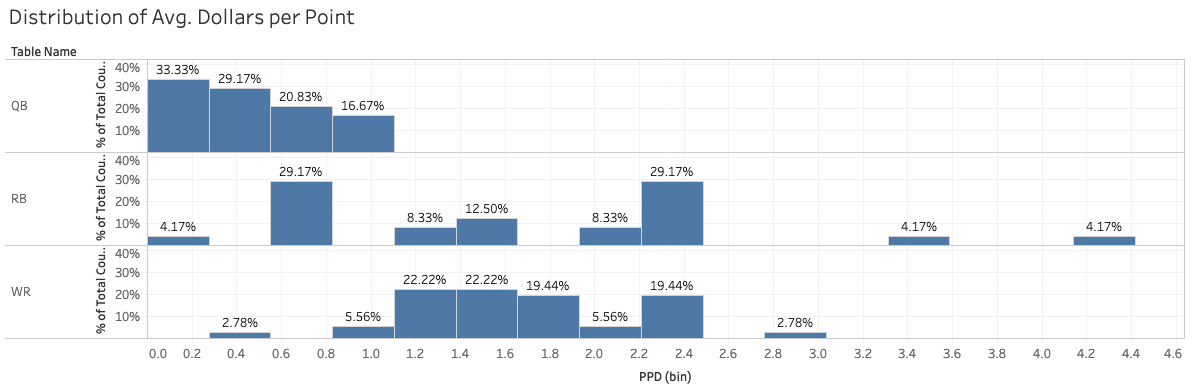
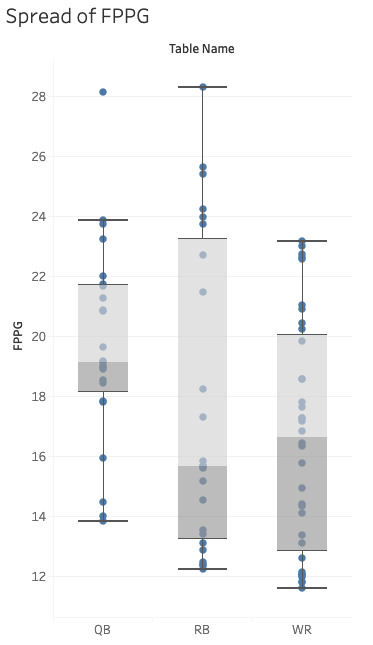
To explore the potential effect of such an adjustment, I tried to measure a proxy of “relative value”, which is generally how the draft values are determined. I started by pulling the fantasy points per game (FPPG) for the top 24 QBs and RBs (2 starters in a 12-teamer) and top 35 WRs (3 starters in a 12-teamer) from 2018. The full analysis can be found at the following link:
I compared the FPPG with their peak auction values (to account for injuries, retirements, AB craziness, etc.) to yield average dollars per point (DPP) and then plotted a histogram to look at the spread of values. You can see that QBs do skew very low on DPP, while WR gives a somewhat normal distribution. RB, as expected, is highly variable, but at least the greatest percentage fall in the middle of the distribution.
I then made a box plot of the spread of FPPG to get a sense of how the distributions compare to each other among positions. Using the link above, you can hover over each area to get information about the players and stats attached to the players. This shows two things: 1) the commonly-held belief that fantasy QB scoring is relatively narrow is true and 2) top RBs and WRs are much more valuable than top QBs, considering the “extra value” they give you.
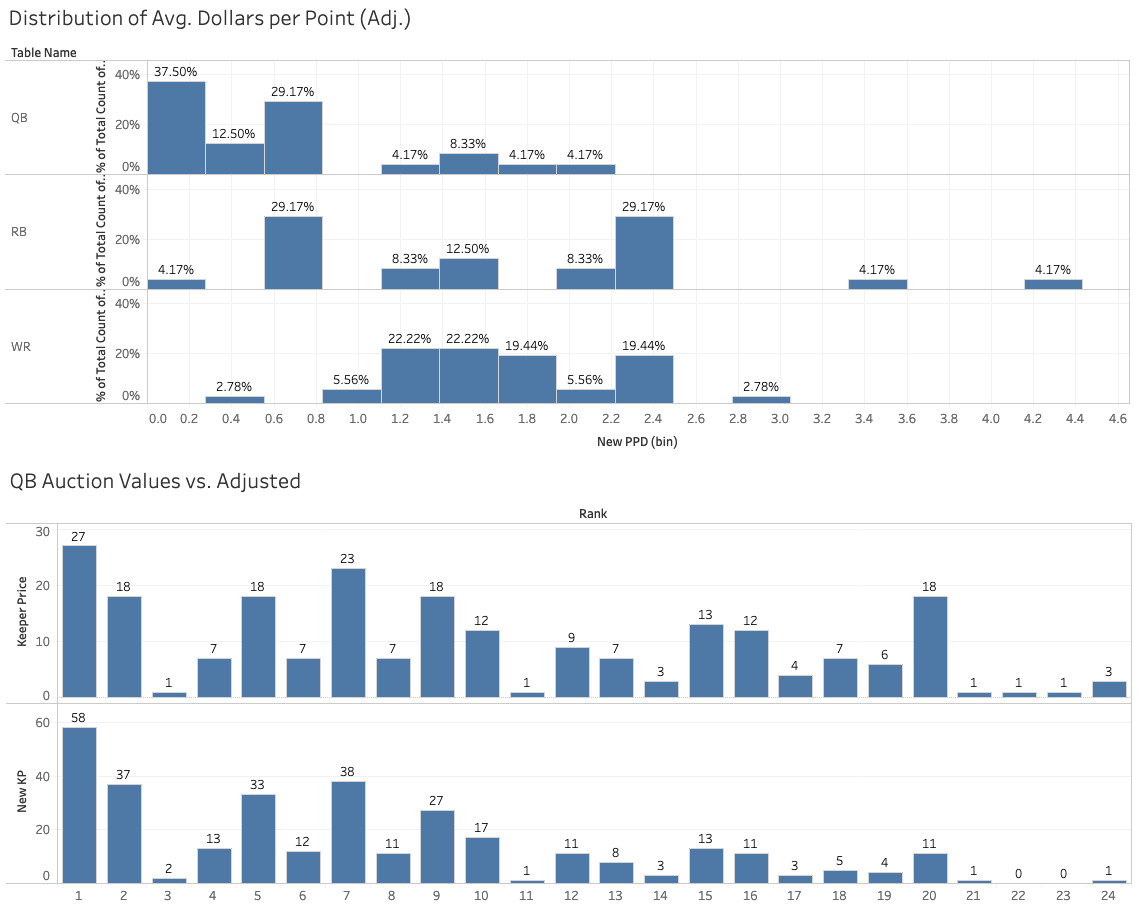
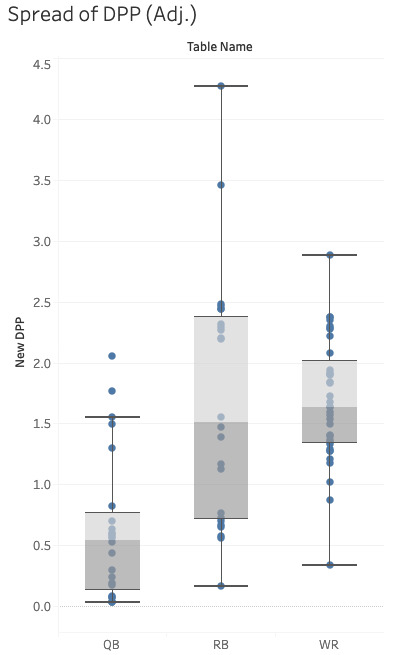
I then did the same thing with DPP to see whether the same thing showed up. Here, it is very apparent that QBs have a narrow range for DPP that is substantially lower. Thus, the goal would be to adjust QB auction values to make the QB box plot and histogram look more similar to the RB/WR and more normally distributed, respectively.

The next figure shows a histogram of this adjustment, which isn’t consistent across all QBs (the formula is somewhat complicated, but you’ll find a comparison of the old and new values here as well). Note on the comparison graph that adjusting the prices doesn’t adjust the relative value by FPPG finish.
Finally, the following box plot shows the DPP after the auction value adjustment. You can see that QB, although still less valuable than RB/WR, looks more like them, especially when you look at the top producers at the position. This means the prices reflect QB value relative to other QBs similar to RB/WR. It’s not perfect, but it’s something I could whip up quickly.
Vote Required: A 2/3 rule (9 teams in a 12-team league) is required for the proposed rule to be confirmed and added to the League Constitution.
Enactment: This rule will affect the rookie draft, veteran auction draft, offseason transactions, or keeper selections. It will be enacted for the 2022-2023 season if confirmed by 2/3 rule.
Click here to go back to the top of the page.
Overview: The proposed rule change would add two (2) IR spots to each roster going forward.
Explanation: In the 2020-2021 season, we voted in a temporary measure to add 2 IR spots to accommodate players who test positive for COVID-19 during the pandemic. This vote is to be taken to determine whether this extension of IR spots should become permanent.
Vote Required: A majority rule (7 teams in a 12-team league) is required for the proposed rule to be confirmed and added to the League Constitution.
Enactment: This rule will only affect roster construction. It will be enacted for the 2021-2022 season if confirmed by majority rule.
Click here to go back to the top of the page.
Overview: The proposed rule change would change the bonus points structure to favor QB production.
Explanation: Currently, the league has the following bonus points structure:
| Offensive Milestone (QB, WR, RB, TE) | Bonus Points |
| 300 Passing Yards | 3 |
| 400 Passing Yards | 3 |
| 500 Passing Yards | 3 |
| 100 Rushing Yards | 3 |
| 150 Rushing Yards | 3 |
| 200 Rushing Yards | 3 |
| 100 Receiving Yards | 3 |
| 150 Receiving Yards | 3 |
| 200 Receiving Yards | 3 |
Under the current system, rushing QBs are often awarded, despite not being good passers. Because QB is more important in general, and specifically because we now have a superflex league, the proposal is to alter the bonus point structure to favor productive passing QBs. The proposed change is to double the bonus points tied to QB passing production, resulting in the following:
| Offensive Milestone (QB, WR, RB, TE) | Bonus Points |
| 300 Passing Yards | 6 |
| 400 Passing Yards | 6 |
| 500 Passing Yards | 6 |
| 100 Rushing Yards | 3 |
| 150 Rushing Yards | 3 |
| 200 Rushing Yards | 3 |
| 100 Receiving Yards | 3 |
| 150 Receiving Yards | 3 |
| 200 Receiving Yards | 3 |
Vote Required: A 2/3 rule (9 teams in a 12-team league) is required for the proposed rule to be confirmed and added to the League Constitution.
Enactment: This rule will affect league scoring, format, schedule, in-season transactions, or prizes. It will be enacted for the 2021-2022 season if confirmed by 2/3 rule.
Click here to go back to the top of the page.
Overview: The proposed rule change would change league scoring to include 0.5 points per first down.
Explanation: In the real football game, QBs throwing first downs enables an offense to stay on the field and represent huge value to an offense. This rule was brought forward to provide fantasy scoring to capture this. Under the current system, rushing QBs are often awarded, despite not being good passers. Because QB is more important in general, and specifically because we now have a superflex league, the proposal is to alter the point structure to favor productive passing QBs. Adding 0.5 points per first down add importance to the QB position (particularly for prolific passing QBs) without completely skewing the points system.
Vote Required: A 2/3 rule (9 teams in a 12-team league) is required for the proposed rule to be confirmed and added to the League Constitution.
Enactment: This rule will affect league scoring, format, schedule, in-season transactions, or prizes. It will be enacted for the 2021-2022 season if confirmed by 2/3 rule.
Click here to go back to the top of the page.
Overview: The proposed rule change would adjust the weekly scoring to add a win for all teams scoring in the top 6 for any given week.
Explanation: I cite this article from The Ringer as evidence:
https://www.theringer.com/nfl/2019/8/6/20755201/fantasy-football-league-settings-improvement-ideas
If an NFL team loses a game 54-51, it means that its defense played spectacularly poorly. If your fantasy team loses a game 140-135, though, you likely didn’t do anything wrong—you just happened to play against Jenna, who picked Todd Gurley and got Patrick Mahomes for $3. What the hell were you supposed to do? It seems patently unfair that you lost while Greg won 78-46 against Cam, the Jets fan in your league who used his first pick on Sam Darnold and then logged out, letting autodraft saddle him with players who were hurt or holding out. (Cam started Le’Veon Bell all year.)
This rule proposal is suggesting what is commonly known as “the doubleheader system”. Here’s how it works: Each week, fantasy teams compete for two wins: one for outscoring their opponent, and one for ranking in the top half of their league in scoring. Win your matchup and record a high enough score, and you’ll go 2-0 in that week. Win your matchup solely because your opponent sucked, or lose your matchup because your opponent had a great week, and you’ll go 1-1. If you lose and deserved to lose, you’ll go 0-2. This method requires extra legwork. Each week you will have to track which teams finished in the top half of the league in scoring, and you’ll need to maintain a set of alternate standings all season.
Vote Required: A 2/3 rule (9 teams in a 12-team league) is required for the proposed rule to be confirmed and added to the League Constitution.
Enactment: This rule will affect league scoring, format, schedule, in-season transactions, or prizes. It will be enacted for the 2021-2022 season if confirmed by 2/3 rule.
Click here to go back to the top of the page.
Overview: The proposed rule change would eliminate the team defense and replace with 3 individual defensive players (IDPs).
Explanation: This article from Dynasty League Football describes IDP:
https://dynastyleaguefootball.com/what-is-an-idp-league/
In most standard fantasy football leagues, each team may have the option of drafting and starting a team defense. That team defense typically scores points for you based on how many points are scored against it, and how many big plays the defensive units generates. While this format makes for an easier-to-manage team, the downside of this format is that the performance of team defensive units usually has more to do with the offense they are playing than the quality of the unit itself. Besides, where’s the fun in choosing an entire half of a team to play as a single unit? You’d never play in a league where you had to start a team offense instead of a QB, RB, WR & TE, would you?
This rule proposal was brought forward because — why not?! We got rid of kickers…it’s about time we handled the team defenses. The proposal would add the following three roster spots in place of the team defense: 1 DL, 1 DB and 1 LB. The scoring for the IDP players would be:
- Tackle Solo: 1
- Tackle Assist: 0.5
- Sack: 3
- Interception: 3
- Fumble Force: 3
- Fumble Recovery: 2
- Defensive Touchdown: 6
- Safety: 2
- Pass Defended: 0.5
- Block Kick: 4
- Extra Point Returned: 2
Here’s a helpful primer from Yahoo on IDP leagues:
https://sports.yahoo.com/introductory-primer-idp-leagues-182202909.html
Vote Required: A 2/3 rule (9 teams in a 12-team league) is required for the proposed rule to be confirmed and added to the League Constitution.
Enactment: This rule will affect league scoring, format, schedule, in-season transactions, or prizes. It will be enacted for the 2021-2022 season if confirmed by 2/3 rule.
Click here to go back to the top of the page.
Overview: The proposed rule change would eliminate the Rookie Draft as currently structured and replace with a Taxi Squad Draft.
Explanation: This rule proposal comes about as the inevitable fix to the compromise that was the Rookie Draft. It would allow an expansion of the number of rookie players that can be added to rosters and eliminate the FAB frenzy for undrafted rookies that takes place following the Veteran Draft.
Draft Rules: The new setup would create a Taxi Squad for each team, comprised of 3 players. The Taxi Squad would be selected by a slow snake draft taking place approximately one month before the Veteran Draft. The draft order would be determined by reverse order of final standings, with the following stipulations:
- The “Best of the Unfresh” winner (7th place) would receive the #1 pick. (Will be #3 pick starting 2022 season)
- The runner-up of the “Putrid” playoff (11th place) would receive the #2 pick. (Will be #1 pick starting 2022 season)
- The “Putrid” winner (12th place) would receive the #3 pick. (Will be #2 pick starting 2022 season)
The following picks will proceed in reverse order of the final standings:
- 10th place: #4 pick
- 9th place: #5 pick
- 8th place: #6 pick
- 6th place: #7 pick
- 5th place: #8 pick
- 4th place: #9 pick
- 3rd place: #10 pick
- 2nd place: #11 pick
- Champion: #12 pick
The draft will proceed for 3 rounds in a snake format to select rookie-eligible players to be added to a team’s Taxi Squad. Once players are added to the Taxi Squad, they cannot be called up to the team until after the Veteran Draft.
Definitions: The following definitions apply:
- Rookie – defined as a player with no prior NFL service time, and who was not listed on the Yahoo Fantasy Football website during the previous fantasy season.
Trading Draft Picks
You may trade your taxi squad draft picks, however please note that you must receive a pick for every pick you trade. No manager may hold more or less than 3 taxi squad draft picks in any given season. You may only trade picks for the upcoming season’s Taxi Squad Draft (no trading future picks allowed).
- If the trade is being completed as part of offseason trading, you may trade draft money in exchange for Taxi Squad draft picks, however the transaction must also contain a “protected” player moving from one team to another. You may not trade only draft money for an exchange of Taxi Squad draft picks.
- If the trade is being completed during the season, at least one player from an active roster must be moved from one team to another. You may not trade solely draft picks.
The rules for the Taxi Squad Draft are the following:
Procedure
- You are eligible to hold up to three (3) players in your Taxi Squad. The first year of the league, all teams will participate in a 3-round Taxi Squad Draft to fill their Taxi Squads.
- Following the initial draft, subsequent Taxi Squad drafts will proceed to fill the Taxi Squads of teams that have available positions.
- The draft will be a slow snake draft that starts on August 1st of the league year and must end by September 1st of the league year. All picks must be completed by September 1st.
- The Taxi Squad draft will proceed according to the “Draft Rules” outlined above.
- If all managers have acquired their maximum players, the remainder of rookie players will be released into free agency. These players will be available to be drafted in the Veteran Draft.
- After Taxi Squads are filled, players may not be called up to the main roster until after the Veteran Draft. There is no cost associated with calling up a player.
- Once a player is called up, the vacated Taxi Squad spot will remain vacant until the Taxi Squad draft of the following season.
- Managers may not trade players on the Taxi Squad. If a manager wishes to trade a Taxi Squad player, they must call them up to the active roster prior to trading them.
- Managers may release a player from their Taxi Squad as they wish. If a player is released from a Taxi Squad during a season, they will automatically be available as a waiver pickup. If a player is released from a Taxi Squad during the offseason, they will be available in the Veteran Draft of the upcoming season.
- Lastly, remember that you don’t have to acquire a Taxi Squad player. This is simply a chance for you to get some prime rookie talent prior to the Veteran Draft.
Roster requirements for Taxi Squad players
- Players procured through the Taxi Squad draft may remain on the team’s roster with Taxi Squad keeper values for 3 seasons. Beginning in Year 4, the player may be kept according to the general keeper policies. The player will not count against the manager’s protected players (6 or fewer for returning managers), and the player will be included in the manager’s keeper player quota (4 or fewer for returning managers).
- Players who are called up can be traded or dropped as normal. Players who are traded will retain their keeper values in Years 1-3 after being called up as outlined below. Players who are dropped will no longer hold their Taxi Squad keeper values, instead resorting to standard keeper values.
- Players who are called up to their rosters are eligible to be kept in the following season (Year 1) according to the following keeper cost schedule:
| Round 1 | 1 | 2 | 3 | 4 | 5 | 6 | 7 | 8 | 9 | 10 | 11 | 12 |
| Keeper Amount | $25 | $25 | $23 | $23 | $21 | $21 | $19 | $19 | $17 | $17 | $15 | $15 |
| Round 2 | 1 | 2 | 3 | 4 | 5 | 6 | 7 | 8 | 9 | 10 | 11 | 12 |
| Keeper Amount | $10 | $10 | $10 | $10 | $10 | $10 | $10 | $10 | $10 | $10 | $10 | $10 |
| Round 3 | 1 | 2 | 3 | 4 | 5 | 6 | 7 | 8 | 9 | 10 | 11 | 12 |
| Keeper Amount | $5 | $5 | $5 | $5 | $5 | $5 | $5 | $5 | $5 | $5 | $5 | $5 |
- The player can be kept by the manager in Year 2 at an increased cost of 20% (above the Year 1 value). The player will not count against the manager’s protected players (6 or fewer for returning managers), nor will the player be included in the manager’s keeper player quota (4 or fewer for returning managers).
- The player can be kept by the manager in Year 3 at an increased cost of 25% (above the Year 2 value). The player will not count against the manager’s protected players (6 or fewer for returning managers), nor will the player be included in the manager’s keeper player quota (4 or fewer for returning managers).
- Beginning in Year 4, the player may be kept according to the general keeper policies. The player will count against the manager’s protected players (6 or fewer for returning managers), and the player will be included in the manager’s keeper player quota (4 or fewer for returning managers).
| Round 1 | Year 1 | Year 2 | Year 3 |
| 1 | $25 | $30 | $38 |
| 2 | $25 | $30 | $38 |
| 3 | $23 | $28 | $35 |
| 4 | $23 | $28 | $35 |
| 5 | $21 | $25 | $32 |
| 6 | $21 | $25 | $32 |
| 7 | $19 | $23 | $29 |
| 8 | $19 | $23 | $29 |
| 9 | $17 | $20 | $26 |
| 10 | $17 | $20 | $26 |
| 11 | $15 | $18 | $23 |
| 12 | $15 | $18 | $23 |
| Round 2 | Year 1 | Year 2 | Year 3 |
| 1 | $10 | $12 | $15 |
| 2 | $10 | $12 | $15 |
| 3 | $10 | $12 | $15 |
| 4 | $10 | $12 | $15 |
| 5 | $10 | $12 | $15 |
| 6 | $10 | $12 | $15 |
| 7 | $10 | $12 | $15 |
| 8 | $10 | $12 | $15 |
| 9 | $10 | $12 | $15 |
| 10 | $10 | $12 | $15 |
| 11 | $10 | $12 | $15 |
| 12 | $10 | $12 | $15 |
| Round 3 | Year 1 | Year 2 | Year 3 |
| 1 | $5 | $6 | $8 |
| 2 | $5 | $6 | $8 |
| 3 | $5 | $6 | $8 |
| 4 | $5 | $6 | $8 |
| 5 | $5 | $6 | $8 |
| 6 | $5 | $6 | $8 |
| 7 | $5 | $6 | $8 |
| 8 | $5 | $6 | $8 |
| 9 | $5 | $6 | $8 |
| 10 | $5 | $6 | $8 |
| 11 | $5 | $6 | $8 |
| 12 | $5 | $6 | $8 |
Vote Required: A 2/3 rule (9 teams in a 12-team league) is required for the proposed rule to be confirmed and added to the League Constitution.
Enactment: This rule will affect the format of the rookie draft. It will be enacted for the 2021-2022 season if confirmed by 2/3 rule.
Click here to go back to the top of the page.
PROPOSED RULES FOR 2022-2023:
Overview: The proposed rule change would institute a minimum draft budget for the Veteran Auction Draft ($50).
Explanation: At the moment, there is no minimum amount with which teams can go into the Veteran Auction Draft. With more players eligibile to be rostered via Taxi Squad picks, this may result in some teams having tremendous financial flexibilty while others may be in financial peril.
This rule proposal would require each team to make sure they enter the draft with enough money to field a competitive team. Managers would need to eliminate salaries that may take the beyond the draft budget minumum through trades or releasing players into the draft.
Vote Required: A 2/3 rule (9 teams in a 12-team league) is required for the proposed rule to be confirmed and added to the League Constitution.
Enactment: This rule will affect the Veteran Auction Draft and off-season transactions. It will be enacted for the 2022-2023 season if confirmed by 2/3 rule.
Click here to go back to the top of the page.
Overview: The proposed rule change would tweak the Taxi Squad rules to say that traded Taxi Squad players revert to normal keeper prices and roster spots, instead of maintaining their Taxi Squad eligibility.
Explanation: This rule proposal was brought forward because of a slight loophole in the Taxi Squad rules that would allow a team to bring as many players into the Veteran Auction Draft as desired by simply acquiring multiple Taxi Squad players who have been called up by other teams. The exact formulation of this proposal was a compromise between Brandon, Skip, and Chad after discussing the merits and benefits of the current Taxi Squad rules.
The current League Constitution states the following: “Players who are traded will retain their keeper values in Years 1-3 after being called up as outlined below. Players who are dropped will no longer hold their Taxi Squad keeper values, instead resorting to standard keeper values.”
The proposed rule would change the language to: “Players who are traded or dropped will no longer hold their Taxi Squad keeper values, instead resorting to standard keeper values and standard keeper requirements.”
Vote Required: A majority rule (7 teams in a 12-team league) is required for the proposed rule to be confirmed and added to the League Constitution.
Enactment: This rule will affect the Taxi Squad draft and in-season transactions. It will be enacted for the 2022-2023 season if confirmed by majority rule.
Click here to go back to the top of the page.
Overview: The proposed rule change would provide a semi-reset of the league in the 20th season (2026-2027) by releasing all keepers to the Veteran Auction Draft. Taxi Squad picks (if applicable) would remain tied to managers.
Explanation: We’ve been at this thing for a long time, and the dynasty aspect has been very enjoyable. But even the best dynasty leagues eventually do a reset to shake things up, and 20 years seems like a good time to do just that. Of course, we wouldn’t simply be doing the reset and calling it a day. This would be part of a bigger 20th year celebration where we will plan a trip to the NFL Hall of Fame in Canton, OH and do the first EF Live Veteran Auction Draft! The draft would be done offline, but would be accessible by anyone, regardless whether you make the trip to Canton.
The reason it is being presented so early is so EVERYONE can plan around the anticipated reset as they are making transactions over the next few years.
Thanks to Shane for this suggestion!
Vote Required: A 2/3 rule (9 teams in a 12-team league) is required for the proposed rule to be confirmed and added to the League Constitution.
Enactment: This rule will affect the Veteran Auction Draft. It will be enacted for the 2022-2023 season if confirmed by 2/3 rule.
Click here to go back to the top of the page.
PROPOSED RULES FOR 2023-2024:
Overview: The proposed rule change would change the provisions of the semi-reset of the league in the 20th season (2026-2027) to include any players procured by a manager through the Rookie Draft or Taxi Squad Draft (regardless whether they have converted to regular keepers) in the players that cannot get released into the Veteran Draft.
Explanation: Last year, we voted to do a semi-reset, where all keepers would be released to the Veteran Auction Draft. Taxi Squad picks (if applicable) would remain tied to managers. This would be part of a bigger 20th year celebration where we will plan a trip to the NFL Hall of Fame in Canton, OH and do the first EF Live Veteran Auction Draft! The draft would be done offline, but would be accessible by anyone, regardless whether you make the trip to Canton.
The proposed modification would help maintain the dynasty-like play of the league by allowing managers to keep all players they procured through the Rookie Draft or players that were on their Taxi Squad, even after they have lost Rookie Draft or Taxi Squad pricing status. Although it is a minor change to the passed rule, it is a significant one, as there are many players that would have been released into free agency that no longer would be.
Vote Required: A 2/3 rule (9 teams in a 12-team league) is required for the proposed rule to be confirmed and added to the League Constitution.
Enactment: This rule will affect the Veteran Auction Draft. It will be enacted for the 2023-2024 season if confirmed by 2/3 rule.
Click here to go back to the top of the page.
PROPOSED RULES FOR 2025-2026:
Amendment Proposal 2024-001
Overview: The proposed rule change would allow players traded in offseason transactions to be traded or released into the draft during the same offseason. This rule change would not apply to transactions in which only draft money is traded to acquire a player.
Explanation: This rule change aims to provide greater flexibility in managing rosters during the offseason by allowing players acquired in trades to be either traded again or released into the draft pool before the season begins. Under the current system, teams may feel restricted when making offseason trades, as they are forced to keep newly acquired players until the regular season or make less strategic decisions under the existing rules.
By permitting subsequent trades or releases, this rule would encourage more dynamic roster management, promote strategic decision-making, and increase overall league activity in the offseason. However, the rule would not apply to transactions involving only draft money (i.e. no players being swapped between both teams), ensuring that teams cannot manipulate the draft economy by flipping assets multiple times in a single offseason. This maintains the competitive balance and integrity of draft-related transactions while still allowing flexibility for standard player trades.
Vote Required: A majority rule (7 teams in a 12-team league) is required for the proposed rule to be confirmed and added to the League Constitution.
Enactment: This rule will affect offseason transactions. It will be enacted for the 2025-2026 season if confirmed by majority rule.
Click here to go back to the top of the page.
Amendment Proposal 2024-002
Overview: The proposed rule change would allow players listed as “Doubtful” (D) to be placed in the IR spot.
Explanation: This rule change would allow fantasy managers to place players designated as “Doubtful” (D) on the injury report into an Injured Reserve (IR) spot, providing additional roster flexibility when managing injuries. Currently, many leagues restrict IR eligibility to players listed as “Out” (O) or on Injured Reserve (IR), which can make it difficult for managers to navigate late-week injury uncertainties.
By expanding IR eligibility to include Doubtful (D) players, this rule helps managers avoid the frustration of holding onto an injured player while still maintaining roster depth for active matchups. Since players listed as Doubtful historically have a very low chance of playing, this adjustment aligns with the purpose of the IR spot—allowing teams to replace injured players without being forced to drop key assets. The rule would not impact competitive balance but would instead enhance strategic decision-making and roster flexibility for all managers.
Vote Required: A majority rule (7 teams in a 12-team league) is required for the proposed rule to be confirmed and added to the League Constitution.
Enactment: This rule will affect in-season transactions. It will be enacted for the 2025-2026 season if confirmed by majority rule.
Click here to go back to the top of the page.
Amendment Proposal 2024-003
Overview: The proposed rule change would enable the setting of “Waivers to FA” on Sunday only, to provide managers with the opportunity to make roster moves to compensate for late injury scratches, etc.
Explanation: This proposed rule change would allow waived players to immediately become free agents on Sundays only, rather than going through the standard waiver process. This adjustment is intended to give managers the ability to make last-minute roster moves in response to unexpected injury scratches or other late-breaking news before games begin.
Under the current system, if a player is dropped, they often go through a waiver period that prevents immediate pickup, which can leave managers with limited options to adjust their lineups when a sudden injury occurs. By enabling Waivers to Free Agency on Sundays only, this rule provides a balanced solution—ensuring that waiver priority is still relevant throughout the week while giving managers more flexibility on game day to field a competitive lineup. This would reduce the frustration of last-minute inactive designations while keeping the integrity of the waiver process intact for the rest of the week.
Vote Required: A majority rule (7 teams in a 12-team league) is required for the proposed rule to be confirmed and added to the League Constitution.
Enactment: This rule will affect in-season transactions. It will be enacted for the 2025-2026 season if confirmed by majority rule.
Click here to go back to the top of the page.
Amendment Proposal 2024-004
Overview: The proposed rule change would remove the constitutional clauses permitting commissioner lineup changes and enable the setting in Sleeper for “Player Auto Subs” to be retroactive. This would allow managers to control their subs in the event of last-minute changes, rather than needing the commissioner to make substitutions.
Explanation: This proposed rule change would eliminate the constitutional clauses allowing the commissioner to adjust lineups and instead enable Sleeper’s “Player Auto Subs” setting to be retroactive. The goal of this change is to place full control of lineup management in the hands of each individual manager, reducing the need for commissioner intervention while ensuring fair and consistent roster adjustments.
Currently, in the event of a last-minute injury scratch or unexpected inactive player, the commissioner may need to step in to make a substitution, which can be time-consuming and introduce potential concerns about fairness or impartiality. By enabling retroactive auto-subs, managers would have the ability to set preferred substitution rules in advance, allowing for automated, transparent, and consistent lineup adjustments without requiring commissioner involvement.
In the League Constitution, the following clause will still remain, but will only be used if a manager does not set their auto sub preferences on their own:
Once players’ games have begun, those players are “locked” for that week. The commissioner may not alter the starting lineup of manager once games have begun, unless the manager’s team is configured such that it disrupts the competitive balance of the league. This circumstance includes:
- Deliberately not starting players to allow the opposing team to win
- Starting injured, inactive, or suspended players
- Starting players during their bye week
As a general rule, any player who is designated as “D” (doubtful), “O” (out), “IR” (injured reserve), “N/A” (not active), or “COVID-19” (positive COVID test) in the starting lineup after games begin will be replaced by the player on the manager’s bench with the highest projected point total for the given week that is eligible for that roster position.
Vote Required: A majority rule (7 teams in a 12-team league) is required for the proposed rule to be confirmed and added to the League Constitution.
Enactment: This rule will affect in-season transactions. It will be enacted for the 2025-2026 season if confirmed by majority rule.
Click here to go back to the top of the page.
Amendment Proposal 2024-005
Overview: The proposed rule change would remove managers’ ability to add Monday Night players from waivers on Monday. Please note that this, combined with Proposal 2024-004, would allow managers the greatest flexibility to set their lineups competitively.
Explanation: This proposed rule change would prevent managers from adding players from waivers on Monday if they are playing in that night’s game. The purpose of this rule is to ensure that roster decisions are made in advance and to prevent potential exploitation of last-minute waiver pickups for Monday Night Football matchups.
When combined with the proposed retroactive “Player Auto Subs” setting (Proposal 2024-004), this rule provides maximum flexibility for managers to set their lineups competitively without relying on late waiver adds. The auto-sub feature allows managers to prepare for unexpected changes, ensuring fair and strategic roster management throughout the week. By removing Monday waiver pickups, this rule encourages more thoughtful, proactive roster planning while maintaining a level playing field for all teams.
Vote Required: A majority rule (7 teams in a 12-team league) is required for the proposed rule to be confirmed and added to the League Constitution.
Enactment: This rule will affect in-season transactions. It will be enacted for the 2025-2026 season if confirmed by majority rule.
Click here to go back to the top of the page.
Amendment Proposal 2024-006
Overview: The proposed rule change would increase the league buy-in and prize money, doubling the buy-in and adjusting payouts accordingly.
Explanation: This proposed rule change would change the league buy-in from $105 to $210. Payouts would also be changed accordingly:
Payouts
The end-of-season payouts for the league are as follows:
Fantasy League Champion: $1200
Fantasy League Runner-up: $500
Fantasy League Third Place: $210
Most Fantasy Points in the Season: $210
Most Fantasy Points in a Week (Weeks 1-3, 7-11): $25
Most During Points in Rivalry Week (Weeks 4-6, 12-14): $35
The total pot ($2520) is split as follows:
| Amount | Percent | |
| Champion | $1200 | 48% |
| Runner-up | $500 | 20% |
| Third Place | $210 | 8% |
| Most Points (Season) | $200 | 8% |
| Most Points (Weekly) | $200 | 8% |
| Most Points (Rivalry Week) | $210 | 8% |
| TOTAL | $2520 | 100% |
As you can see, the adjustments come in the weekly high points payouts and the season high points payout.
Vote Required: A 2/3 rule (9 teams in a 12-team league) is required for the proposed rule to be confirmed and added to the League Constitution.
Enactment: This rule will affect league format and prizes. It will be enacted for the 2026-2027 season if confirmed by 2/3 rule.
Click here to go back to the top of the page.
Amendment Proposal 2024-007
Overview: The proposed rule change would increase the maximum number of allowed keepers at a single non-QB position to four. Under this rule change, managers would still only be allowed to keep one QB. The total number of keepers allowed would be unchanged.
Explanation: Under the Current League Constitution, returning team managers may keep up to four (4) “locked” players from the previous season (called a “Keeper”). Keeper players are eligible to be picked from any of the roster positions (QB, WR, RB, TE, and DEF) on a team’s final roster. Only a maximum of two (2) players can be kept at any one position (with the exception of QB, for which only one player may be kept).
This proposed rule change would increase the maximum number of allowed keepers at a single non-QB position from two (2) to four (4), while maintaining the existing rule that each manager may only keep one quarterback in addition to keeping the total keepers at 4 players.
This proposal enhances the dynasty-like appeal of the league, giving managers more control over their core players while still preserving competitive balance by requiring the majority of rosters to be refreshed through the draft. Keeping the one-QB restriction ensures that elite quarterback talent remains available in the draft pool, preventing any positional imbalance.
Vote Required: A 2/3 rule (9 teams in a 12-team league) is required for the proposed rule to be confirmed and added to the League Constitution.
Enactment: This rule will affect the Taxi Squad Draft, Veteran Auction Draft, offseason transactions, or keeper selections. It will be enacted for the 2026-2027 season if confirmed by 2/3 rule.
 extraordinarilyfreshffl.com